Perspectives from a Sport Administration Master’s Professor

A career working in sport administration is something many people dream about. The industry includes former athletes who made the shift from playing sports to working as a sport professional — and other sport-loving enthusiasts who found this type of work to be the place to focus their career aspirations. Working in sport administration offers diverse, exciting career opportunities that extend beyond working with household-name athletes and mega-million marketing budgets. Today’s sport management professionals find success and job satisfaction in high school and intercollegiate athletic programs, too.
Sport Administration Professor’s Perspectives
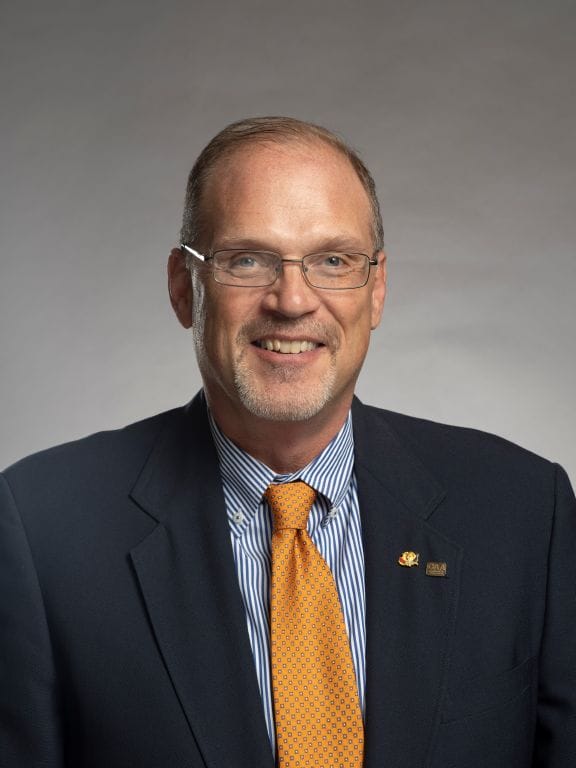
MS SPAD Program Expectations
Students find success in completing the online sport administration master’s program just like they do in other aspects of their life. “You have to be a good manager of your time and be disciplined. There are so many distractions today — social media, what’s going on in the world around us and life in general.” Dr. Kelley is forthright in how he communicates the program’s expectations to prospective students. “We talk about the work they’ll be required to put into their master’s studies, the many deadlines and how they’ll need to use their organizational and communication skills.”
Sport Degree Program Elements
The world of sport administration and management changes and adapts, and the university’s program evolves with it. Dr. Kelley cites the practical applications of the coursework, saying “We’re not just having people write a paper for the sake of it. There’s a strategic outcome in that we want students to develop skill sets that are highly valued by the sport industry.” The master’s program coursework includes financial, operational, facilities, marketing and managerial strategies, as well as what might be lesser-known areas to some students — such as sport governance, legal and compliance issues, as well as risk management, to name a few. “Our courses are all through the lens of what’s happening today in high school and intercollegiate athletics,” says Dr. Kelley.
Difference Between Sport Administration and Management
Dr. Kelley explains that people working in the sport industry use different terms for what is virtually the same type of work and degree program. “If you’re in a more professionally based field, ‘sport management’ might be the moniker. If you work in education or have an interest to do so, like most of our master’s program students, ‘administration’ is the more common term.” For more on this topic, see Sport Administration vs. Sport Management — Which Degree is Right for You?
Experienced Faculty and Real-World Coursework
Today, people interested in a sport administration degree have many opportunities to find a school and program that best fits their needs. Dr. Kelley believes the University of Cincinnati’s online program is one of the best. “What attracts students to us is our experienced faculty. We represent over 40 years of experience in the field,” says Dr. Kelley. “Some of us have deep experience in research and compliance. Others were teachers, coaches and athletic directors. We bring this collective expertise to our program every day.” Another appealing aspect is the university’s community partnerships and the grant work students get to do. Dr. Kelley recalls one grant fundraising effort that benefited Milford High School in Milford, OH. “They wanted to get new turf for the school’s soccer field. One of our students worked with the school’s athletic director and helped him successfully apply for a National Football League’s Grassroots Grant, which included following its detailed requirements.” Dr. Kelley shares another example of the program’s partnership with area schools — a capstone project where a student developed a manual for a high school basketball program. “It included everything from how to open up the gym to what keys to use and running a basketball event from A to Z.” Solving real-world problems, such as these, is a win/win that benefits the students and partner schools. “Being an athletic director is often a one-man band role at the high school level. You’re a fundraiser, the concessions coordinator, and you deal with student-athlete compliance, among a variety of other tasks. And the responsibilities are even greater and more specialized at the college level,” Dr. Kelley says. Students are also exposed to other sport practitioners, so they can learn what it’s like to work in the industry. They’re introduced in-person or via a Zoom conference or through specially produced informational videos.
Opportunities for Women in Sport Administration
Historically, the sport administration and management industry was male-dominated. But Dr. Kelley sees that changing. “Women have more opportunities today,” he says. “There’s coaching and also fundraising and development, the lifeblood of every program, marketing and student athlete services.” A look to the broader sport industry supports the idea that change is happening. Female leaders in sports are making news, including the Women’s National Basketball Association’s hiring of its first-ever female commissioner, Cathy Engelbert. Also in 2019, former National Hockey League executive Jessica Berman was named deputy commissioner of the National Lacrosse League — the first time a woman has held this title in a men’s sport.
Future of Sport Management Degree Program
The future looks bright for the University of Cincinnati’s Master’s of Science in Sport Administration program. “We’re only in our third year of existence,” says Dr. Kelley. “As our program grows and continues to gain even greater recognition, we will be able to work with more students from across the U.S. and internationally.” Dr. Kelley says that a recent student applicant is working for one of the largest sporting apparel companies in the country and is applying for the master’s program. “The more diverse individuals we have in our program, the more it sets every student up for success. Networking opportunities increase and they get exposure to the broader sport industry.” He also cites the university’s critical partnerships with national and state associations, such as the National Federation of State High School Associations and the Ohio High School Athletic Association. “To have these partnerships and the ability to promote our program through the associations’ physical and digital channels is great. My hope is that we continue to grow our program, bringing more opportunity for students to learn about athletics and sport in general. We’re playing a part in bettering the community, the profession and in the lives of our students.”