Online MA in Arts Administration
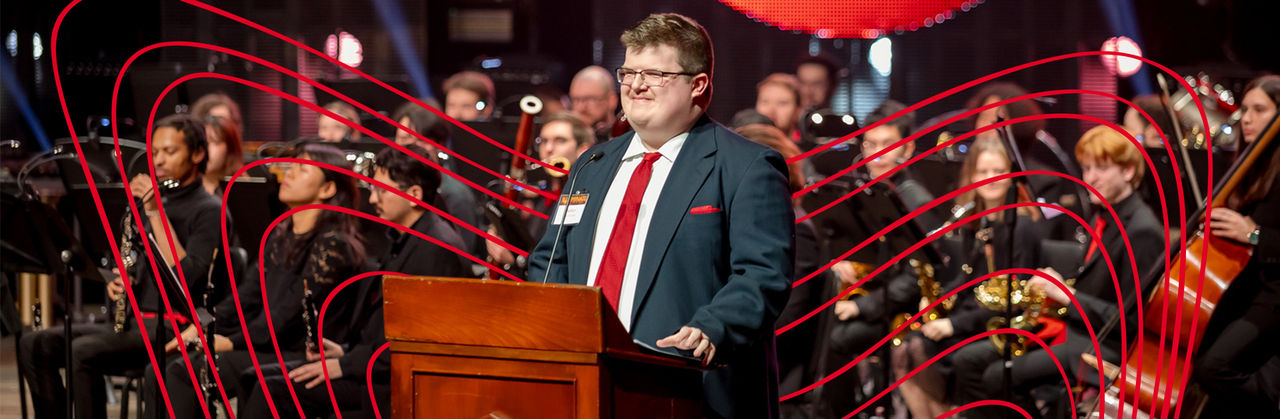
Combine your passion for the arts and culture with the leadership, strategy, and vision to move the field forward. The University of Cincinnati's online Master of Arts in Arts Administration program, with dual-degree options in business and law, prepares working arts and culture professionals for leadership shaped by their own goals and the communities they serve.
Program Overview
What will the future of arts and culture look like, and how will you help shape it?
The University of Cincinnati's Master of Arts in Arts Administration program is designed for cultural visionaries to imagine and build what comes next.
By bringing together arts administration and business strategy, UC's College-Conservatory of Music prepares experienced arts and culture professionals to lead organizations, question inherited models, and develop new possibilities for the field. Through a flexible, asynchronous learning experience, students will deepen their leadership practice while applying what they learn directly to the organizations, neighborhoods, and cultural ecosystems that they already serve.
But this program isn't simply about your next title. It's about developing the knowledge, strategy, and imagination to shape the future of arts and culture, and about asking what kind of field we will leave to the artists, audiences, and leaders who come after us.
Online MA in Arts Administration
High Quality Education
Students in the Online Master of Arts in Arts Administration program are not waiting for the future of the field, they're building it.
Designed for cultural visionaries already working in arts, culture, and adjacent creative fields, the program pairs rigorous training in leadership, strategy, and management with close study of the forces shaping the field; how resources flow, how decisions get made, and who has a seat at the table. Students will examine existing organizationsl models and develop the strategic, financial, and leadership capacity to reimagine them so that artists, organizations, and communities can thrive for generations.
Throughout the program, students bring the real challenges they are navigating in their own organizations, communities, and creative practices into the learning environment, making the curriculum immediately relevant to their work. Courses in the program will explore areas such as:
- Arts and cultural organizations, systems, and structures
- Leadership, philanthropy, and resource development
- Financial management and sustainable business models
- Emerging trends in arts marketing and audience engagement
- Cultural policy, politics, and advocacy
- Governance and leadership in arts and culture
These areas provide students with more than just the skills to manage arts organizations. They build the vision, strategic thinking, and expansive leadership needed to imagine new possibilities and help build a future where arts and culture thrive in every community.
A Dual-Degree Pathway for Emerging Leaders
UC's Master of Arts in Arts Administration program also offers a unique dual-degree pathway that allows students to specialize in business or legal aspects of the fine arts field. Students enrolled in this program will have the option to earn two master's degrees simultaneously, opening additional career paths for them upon graduation.
Made possible thanks to partnerships with the Carl H. Lindner College of Business, and the Donald P. Klekamp College of Law, students will have the opportunity to earn a Master of Business Administration or Master of Legal Studies degree in addition to their Master of Arts in Arts Administration degree.
In the job market, this gives our graduates a competitive edge by holding two master's degrees from some of the most prestigious business, legal, and fine arts colleges in the country.
Flexibility
- 100% online instruction with annual in-person executive sessions
- Enroll in the spring, summer, or fall semesters
- Part-time offering allows for degree completion for working professionals
Support from Application through Graduation
At UC, you’ll have a full support team behind you:
Enrollment Services Advisor: Your go-to resource during the application process
Student Success Coordinator: Helping you prepare for classes and stay on track
Access to Resources: Access to university resources that will support you through your program including online learning expectations and resources, health and wellness resources, and academic support
Admission Requirements
Prerequisites
- A bachelor’s degree from a regionally or nationally accredited college/university.
- An overall 3.0 GPA (on a 4.0 scale) or higher from all previous undergraduate coursework.
- Proof of English proficiency if English is not the applicant’s native language.
Admission Materials
- Resume or CV.
- Transcripts.
- Visionary Statement.
- One letter of reference.
Complete the online application and submit the application fee.
Standard Application Fees:
- $65.00 for domestic applicants to most degree programs
- $70.00 for international applicants to most degree programs
- $20.00 for domestic applicants to Graduate Certificates
- $25.00 for international applicants to Graduate Certificates
- Application fees are waived for Summer 2026 applications submitted by March 1st, 2026
- Application fees are waived for Fall 2026 applications submitted by July 1st, 2026
- Fee waivers are automatically applied for applicants who:
- are currently serving in the US armed forces
- are veterans of the US armed forces
All applicants are required to upload unofficial transcripts during the application process, showing all undergraduate and graduate course work completed, including degrees granted and dates of conferral.
Official transcripts are not required until the student has received and accepted an offer of admission from the university. Once the offer has been confirmed, the student must submit official transcripts.
Students who have received degrees from the University of Cincinnati do not need to submit official paper copies of their UC transcripts.
Transcripts can be submitted electronically or by mail. To see if your transcript(s) can be ordered electronically, visit the links below and search for your previous school(s).
- Parchment
- Please select “University of Cincinnati – Main Campus” as the recipient of your transcript.
- National Student Clearinghouse
- Please have your transcript sent directly to admissions@uc.edu.
If you do not see your past school(s) listed on either site, please contact the school(s) directly. Then, mail your sealed, unopened, official transcripts to:
Please mail sealed, unopened, official transcripts to:
University of Cincinnati
Office of Admissions
PO Box 210091
Cincinnati, Ohio 45221-0091
Transfer Credits for Advanced Standing
Up to 12 of graduate credits may be transferred. Talk to your enrollment advisor to discuss specifics and how to start the petition process.
Current resume or curriculum vitae.
Two letters of reference from individuals who know you professionally or academically.
Applicants will need to provide a letter detailing their interest in the program and how it may match future professional goals.
Applicants with an undergraduate GPA below 3.0 will need to receive a score of 297 or higher on their GRE or request for a GRE waiver.
For International students, an English proficiency test:
- TOEFL minimum Internet-based 80
- Paper-based 520
- Computer-based 190
- IELTS minimum 6.5
Curriculum
For the online Master of Arts in Arts Administration program, the curriculum includes:
- 20 semester credit hours of core and foundational courses in arts administration and business
- 10 semester credit hours of elective courses in arts administration and business to satisfy degree requirements
- 3 semester credit hours in the program's capstone experience
| Course | Title/Description | Credit |
|---|---|---|
| AADM 7071 | Introduction to Arts Administration This course offers an introduction to the theory and practice of American not-for-profit arts administration and serves as an introduction to the overall Arts Administration MA/MBA curriculum. The course opens with an examination of the history, scope and context of the American not-for-profit sector, including economic, political and legal aspects. The not-for-profit arts sector is then examined in this context, withparticular attention to the question of public funding of the arts in America. The second sectionof the course consists of an introduction to critical issues related to the practice of not-for-profit arts administration. The topics of mission, governance & leadership, financial management and the development of revenue resources to support mission are outlined. Learning will be achieved through readings, class discussions and small group projects. Grading is based on class participation, essays, small group project presentations and final learning portfolio. |
3 |
| AADM 7080 | Introduction to Financial Management for Not For Profit Arts Organizations This course provides an introduction to the principles, theories and practices of financial management as they apply to professional not-for-profit arts organizations. |
2 |
| AADM 7099 | Programming and Operations for the Performing Arts II As a continuing course in programming and operations of a performing arts organization, you will have the tools to conceive, develop and budget for a model subscription series or multi-performance presentation. In addition, study of the professional artist contracting process, including a mock negotiation, will familiarize you as a future arts manager of the world of agents and producers. Also, important topics in Human Resources will be explored in the mission-based nfp setting, focusing on labor law, employment practices and policy structures that will culminate in the study of the National Labor Relations Act, union structures and collective bargaining strategies. The last part of the course will involve two teams from the class in a simulated real-time union/management CBA negotiation for a large performing arts organization. |
2 |
| AADM 8020 | Governance and Leadership in Non-Profit Organizations Student teams are assigned to actual Cincinnati area professional arts organizations as consultants to facilitate a self-assessment, capacity building and strategic business planning project. Students work with Board, artistic and executive leaders and staff to refine the mission and longer-term goals of the organization; assess current capacities in all areas of operation; identify where capacities can and should be strengthened; and set specific objectives, strategies and action plans to better fulfill the mission and achieve the longer-term goals. |
2 |
| AADM 8081 | Advanced Topics in Patron Development Once a patron has found your organization, how do you keep them engaged? In this course, we will explore contemporary fundraising and engagement tools and the patron development model. Student will learn about the solicitation of major gifts from prospect research to writing case statements to making the ask. Students will also learn to develop metrics for patron engagement and emerging best practices in digital marketing and fundraising. |
2 |
| ACCT 7000 | Foundations in Accounting This course educates students in the fundamentals of finance and accounting. The methods covered are used extensively throughout the MBA program. Topics include: the accounting process that results in the preparation of financial statements for external users, techniques for analyzing a basic set of financial statements, using accounting information to support management decisions, and using time value of money techniques to evaluate capital asset decisions. |
2 |
| BANA 7011 | Data Analysis Introduction to data analysis and statistical methods with focus on practical decisions using quantitative models in a spreadsheet environment. Topics include sources of data, descriptive and graphical statistical methods, probability, distributions, sampling and sampling distributions, estimation, confidence intervals, and hypothesis testing. |
2 |
| ECON 7000 | Foundations in Economics This course provides an introduction to the fundamentals of economics at the graduate level for students without previous economics coursework. Students will be exposed to the essentials of both microeconomics and macroeconomics. Microeconomics topics to be discussed include the supply and demand mechanism,how markets are affected by regulation and taxation, costs of production, and how market structure affects outcomes. Macroeconomic topics to be discussed include the fundamental measures of the aggregate economy, the sources of economic growth, explaining short-run fluctuations in economic activity, and how government policies can affect these fluctuations. A particular focus will be to understand how fundamental economic principles at both the micro and macro level can affect companies, investments, industries, and national economies. |
2 |
| MKTG 7000 | Marketing Foundations The purpose of this course is to provide students with a foundation in Marketing. Concepts such as segmentation, targeting, positioning, customer and market analysis, and basic marketing planning will be introduced. |
1 |
| MKTG 7011 | Marketing For Managers This course aims to describe many phenomena in marketing. As consumers we develop a surface familiarity with the activities and institutions of the market place but we need a closer look at the players, decision-making issues, processes and key lessons from the commercial trading environment. We also intend to develop an understanding of system dynamics and causal linkages in the marketplace. Why do some products fail? How can we structure productive relationships? What will happen to prices when we intensify distribution or advertising? The course takes up these questions and more. |
2 |
| Course | Title/Description | Credit |
|---|---|---|
| AADM 7098 | Programming and Operations for the Performing Arts I At the heart of any performing arts organization'smission is the product that ends up on the stage in front of the audience. Behind every performanceis a complex process of planning, collaborating, decision-making, budgeting and technical savvy. Anunderstanding and appreciation of the complexity of project management, scheduling, budgeting, and technical production is critical for the successful arts manager. In this first course of two, you will have the opportunity to explore the myriad facets of programming and production in nfpperforming arts organizations and how a stage performance evolves from initial concept to opening night. Along with the artistic considerations, arts administrators must navigate the delicate balance between mission and budget and understand the complex technical aspects of today's modern production elements. |
2 |
| AADM 8011 | Cultural Policy Examines issues of cultural policy in the United States and internationally in terms of their impact on the ways in which arts and cultural organizations operate. Topics include definitions of culture, public and private sector policy-making systems, the development of advocacypositions, and how policy is affected by changes in cultural participation patterns. |
2 |
| AADM 8012 | Arts Education and Community Engagement Examines the development of educational and community engagement programs by professional arts organizations in partnership with schools, school districts, state and federal departments of education and community-based arts, humanities and human service agencies. The first half of the course surveys arts education and community engagement assessment research, model arts education and community engagement programs and methodology to establish and sustain partnership programs. In the second half of the course, students develop and present an arts education or community engagement partnership program. |
2 |
| Course | Title/Description | Credit |
|---|---|---|
| MGMT 7012 | Strategic Management This course focuses on both the analytical and structural framework for competitive analysis, as well as the formulation of policy and strategic decisions, the balancing of short run and long run plans, and the evaluation and control of strategic decisions for the business corporation. The academic basis for the class will be largely industrial organization and a resource based view (as a framework for industry analysis and competitive positioning). Our discussion of competitive analysis will focus on understanding the environment the firm competes within and then developing strategies that create a sustainable advantage in that industry. Finally, corporate strategy analyses move beyond the single business arena, and address what businesses the firm should compete in and resource allocation among those units. Thus, we will concern ourselves in this course with both business level and corporate level strategy development and implementation. |
2 |
| MGMT 7014 | Leadership and Organizations This course focuses on concepts and applications related to organizations and the individuals who design and work within them. The goal of the course is to help you better understand and practice individual and organizational management.We will cover micro-level issues (e.g., individual differences and motivation), mid-level issues (e.g., leadership, groups and teams), and macro-level issues (e.g., organizational culture and structure). By focusing on concepts, applications and issues, you will be better able to see and understand organizational phenomena that you might now take for granted. This course will also help increase your understanding of yourself and others so that you can be more effective in the organizations in which you manage and participate. |
2 |
| MKTG 7014 | Systematic Innovation Tools This course focuses on how to create value and growth through innovation in new and existing markets. Students will learn the skills of innovation and how to apply those skills within the context of a marketing strategy framework. Students will apply innovation methods across the entire marketing management continuum including strategy, segmentation, targeting, positioning, and the 4P's. The course will be taught using interactive workshop methods and techniques throughout. Students will first experience these facilitation techniques while learning innovation. They will then learn and practice these techniques so that they can apply them routinely throughout their graduate experience and beyond. |
2 |
| MKTG 7021 | Design Thinking for Business This course introduces design thinking as a business problem solving approach. It overviews design thinking techniques and has hands on practice applying these to classic business challenges. It fosters creativity and teamwork in the increasingly ambiguous business world in which today's business leaders must compete. |
2 |
| MKTG 7037 | Digital Marketing Strategy This course explores how organizations design integrated digital marketing strategies that create meaningful customer experiences across the entire customer journey. Students apply customer insight, behavioral research, storytelling, marketing funnels, AI-enabled tools, and omnichannel communications to develop digital strategies that deliver the right message to the right customer at the right time. Working through an iterative team project, students analyze customer needs, design strategic solutions, evaluate digital tactics, and communicate recommendations supported by evidence and business rationale. |
2 |
| MKTG 7041 | Digital Marketing Strategy A company's most important asset may be its reputation. A powerful way to enhance that reputation is by supporting a relevant and meaningful cause, one that aligns well to the company's brands and to the customers it serves. Marketing for Social Change is all about how to use marketing to further a worthy cause. A well-designed cause marketing program has many benefits which you will explore in this course. |
2 |
| MKTG 7042 | Influencer Marketing Influencers are essential in the marketing mix because their recommendation carries a disproportionate amount of weight. But different products need different influencers to tell the story, and there is an influencer audience for each brand. This course is designed to develop your understanding of influencer marketing and how the various elements fit together, with an emphasis on practical application to building brands. |
2 |
| Course | Title/Description | Credit |
|---|---|---|
| AADM 8001 | Mission, Money, and Strategy in the Arts You may or may not ultimately become the Executive Director or Finance Director of a not-for-profit (nfp) arts organization, but if you work in a nfp arts organization in any management capacity, you will, work with the finances of your organization. In this course, you will have the opportunity to explore the basics of nfp accounting, finances and strategic management. We will review financial statements, audits, form 990s, budgeting, and strategic planning. You will develop an audit analysis, annual budget, program, and operational plan for a model arts organization. |
3 |
Application Deadlines
| Term | Application Deadline | Classes Start |
|---|---|---|
Summer 2027 Fall 2027 Spring 2028 |
January 2, 2027 May 2, 2027 September 2, 2027 |
May 20, 2027 August 23, 2027 January 10, 2028 |
Tuition and Fees
The University of Cincinnati's online programs allow students to pursue degrees without having to quit their jobs. Our online courses offer the same quality education found on campus in a modern format that fits students’ tight budgets and busy schedules.
The University of Cincinnati's online course fees differ depending on the program.
To view tuition information and program costs, visit the Online Program Fees page.

Ready to get started?
We offer over 130 degrees from undergraduate to doctoral programs. Each program is supported by a team of Enrollment Services Advisors (ESAs) who are here to help answer any questions you have.