Study Skills
How you read, take notes, and study shapes how much you get out of every course, and small adjustments to any of the three can make a real difference. These are skills that keep developing throughout your education; what worked in one course, or one season of life, might need adjusting in the next.
This section walks through practical strategies for each, so you can keep refining your approach as your courses—and your life outside of them—change. Jump to:
Reading as a College Student
Reading in college isn't just about finishing chapters. If you've ever finished an assigned reading and still felt like you missed the point, that's not a sign you're a bad reader. It usually means no one ever taught you how to read for a college course. Successful students know how to plan their reading, identify what matters most, and connect what they're learning to assignments and exams.
Most courses will have a formal textbook (in print or electronic), but you may also be asked to read other forms of content including scholarly or business articles, websites, lecture slide notes, and visual tools such as charts, graphs, images, and infographics.
Remember:
- 10 pages of textbook reading are not the same as 10 pages of a scholarly article.
- Technical or data-heavy readings often take longer.
- Schedule more time for unfamiliar topics.
None of that means you're reading "wrong" if it's taking you longer than you expected. It usually just means the strategy needs to match the material. The strategies below can help you read smarter, not longer.
Know What You're Reading
At the beginning of the module/week, review your reading assignments on the course syllabus or module overview. Consider both the type(s) and length of reading assignments.
Next, review your assignment directions. Consider how the readings connect with your assessments. Are you completing chapter quizzes or larger exams? How will you be applying the knowledge to activities, discussions, and written assignments.
Tip: If the content is open (e.g., it does not have a start date), consider looking ahead before the first day of the week/module to help with planning.
Aim to Finish Your Reading Early in the Week
Set a personal goal to complete the reading early in the week. This gives you time for thoughtful reviews. It also reduces stress when life situations arise and gives you a buffer against technology issues with e-books or linked reading materials.
Tip: The first review should be within 24 hours of initial reading. Space out your reviews as you are preparing for quizzes or exams.
Use Reading Strategies That Work
Reading is a constant task as a college student, but how you approach it can differ based on the type of content, your area of study, and how much is assigned for the module. Some reading materials are packed with data; others are primary sources you're asked to analyze. The goal is matching the strategy to the material, not using the same approach for everything.
Reading for Main Ideas vs. Details
Start by determining the purpose of the content. What is it conveying to you? What's the theme or main idea? Once you have that in mind, note details, examples, evidence, and explanations that reinforce or support it as you read.
This strategy helps you recall information and connect details back to the main ideas.
SQ3R: Survey - Question - Read - Recite - Review
In this strategy, you approach reading with a structured plan. It is intended to actively guide you through the content and increase your memory of what you are reading.
- Survey: Title, introduction, headings and subheadings, bold words (usually key vocabulary), visuals, pictures, graphs, summary
- Question: Turn headings into questions; ask what, who, why, how
- Read: Look for answers to your questions; take notes on key concepts, vocabulary, ideas to revisit, and connections to assignments
- Recite: Put main concepts in your own words; write a summary; create study cards or a mind map; discuss your reading with someone else
- Review: Re-read sections that were confusing; look over your notes
Tip: Break readings into manageable chunks (for example, use headings and subheadings to break up the reading time or read for 20 minutes, then take a 5-minute break).
Common Reading Mistakes
Avoid These Mistakes
- Starting all reading on the due date
- Reading without reviewing assignment instructions
- Highlighting everything
- Reading for long periods without breaks
- Never reviewing notes after reading
Instead
- Read early in the week
- Focus on information connected to assessments
- Take brief notes
- Use active reading strategies
- Review material regularly
College reading isn't about memorizing every word. It's about reading with purpose. When you plan ahead, use active reading strategies, and connect your readings to your coursework, you'll spend less time feeling overwhelmed and more time learning effectively.
Explore Additional Resources
For additional resources:
- Check out PLAN: An Active Reading Strategy
- Get help from the UC Learning Commons, which offers workshops designed to help students strengthen academic skills, including reading and study strategies
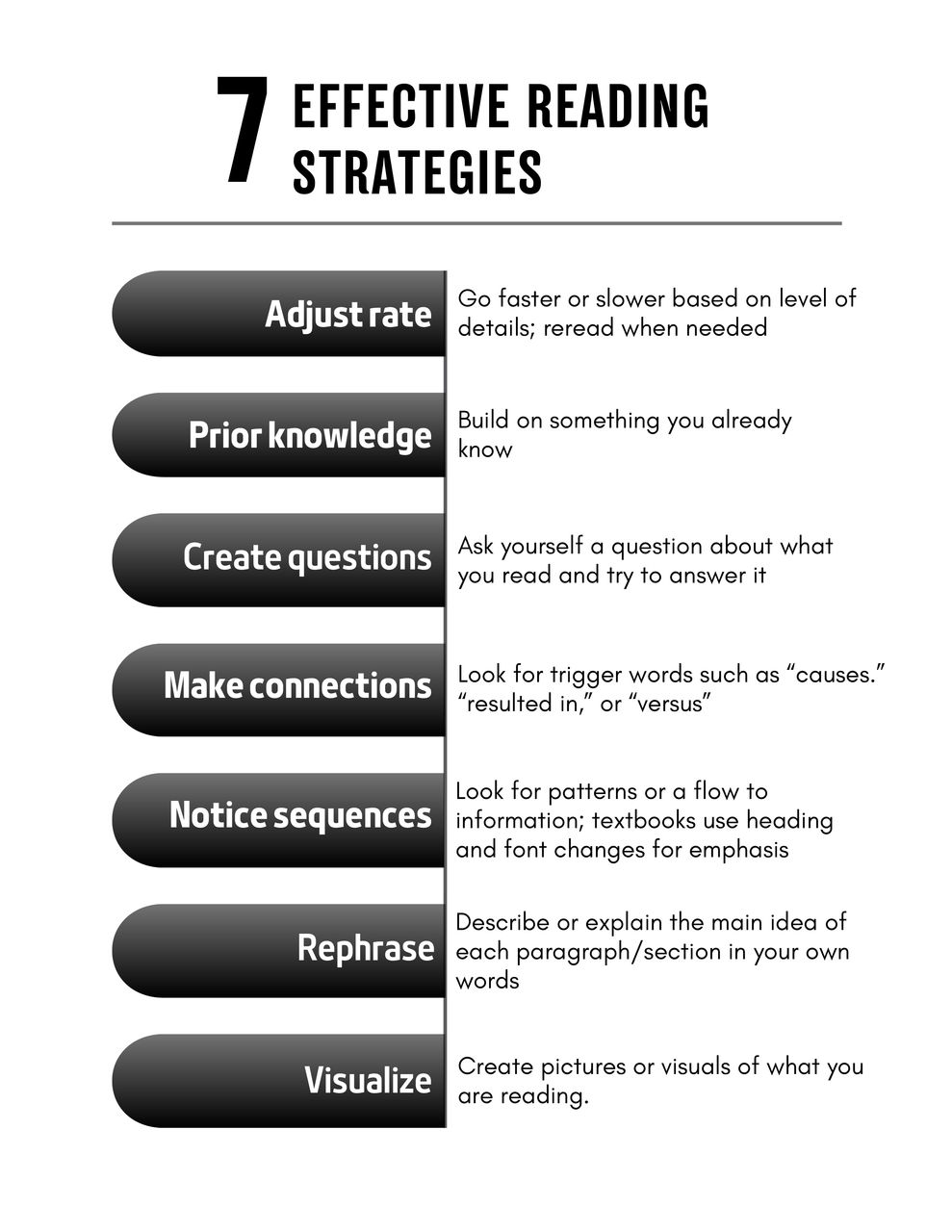
- This infographic summarizing seven effective reading strategies:
Build Knowledge, Not Just Piles of Notes
Online learning puts you in the driver's seat, and that means the strategies you use to engage with course content matter more than ever. Here's something that might come as a relief: the best notetakers aren't the ones writing down the most. They're thinking, connecting, and building knowledge they can actually use.
As an online student, you have flexibility, but you also have to create your own structure. These strategies help you take notes that actually mean something. Your notes can become a study tool, but only if you use them actively.
Know What to Take Notes On
You don't need to write down everything you read, hear, or watch. That instinct to capture it all is understandable, but it usually leads to more notes and less understanding. Instead, focus on information that helps you grasp the course content and prepare for your assignments and assessments.
Look for:
- Main ideas and key concepts
- Definitions and important vocabulary
- Examples
- Processes or steps
- Important dates, formulas, or facts
- Comparisons and differences
- Evidence that supports an idea
- Information emphasized by your instructor
- Connections to assignments, discussions, or quizzes
- Questions or information you don't understand yet
Tip: Don't Copy, Capture
Instead of copying a sentence word-for-word, pause and write the idea in your own words. Putting information into your own words requires you to think about what it means and can make it easier to remember later.
Choose a Notetaking Method That Works for You
There isn't one "right" way to take notes. The best method depends on the course, the type of content, and how you learn.
Cornell Notes
- Cornell Notes divide your page into sections for notes, questions, and a summary.
- Try this when: You are taking notes from lectures, textbook chapters, videos, or other content you will need to review for an assessment.
Outline Notes
- Organize information using headings, subheadings, and indented details.
- Try this when: Course content has a clear structure with topics, subtopics, and supporting details.
Charting
- Organize information into columns so you can compare concepts, people, theories, events, or processes.
- Try this when: You need to identify similarities, differences, characteristics, or relationships.
Mind Maps and Concept Maps
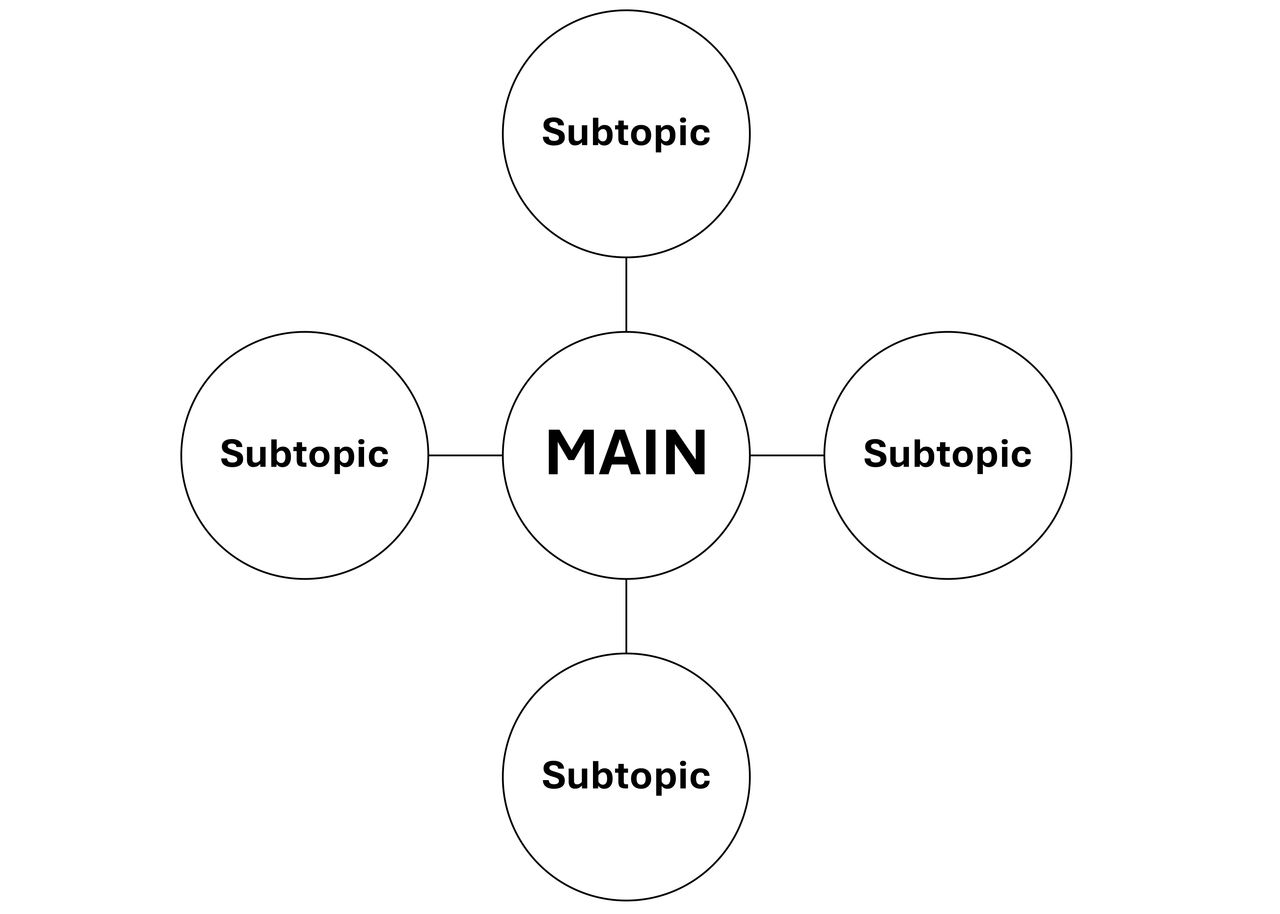
- Start with a central idea and connect related concepts using words, lines, or images.
- Try this when: You need to understand how ideas relate to one another or see the "big picture."
Digital Notes
- You can use a computer, tablet, or phone to create and organize notes using tools such as word processors, note-taking apps, or course technology.
- Try this when: You want to easily search, organize, update, or access your notes across devices.
Remember: The best note-taking system is one you'll actually use and review.
Make Your Notes Active
Taking notes is only the first step. The real value comes from using them to think about what you are learning.
- Summarize: What's the main idea? Can you explain it in your own words?
- Question: What could you be asked about this information? Turn headings or key details into questions you can answer later.
- Connect: How does this connect to something you already know, or to another topic, reading, or assignment?
- Clarify: What don't you understand yet? Mark it so you know what to review, research, or ask your instructor about.
- Apply: How could you use this information — in an assignment, discussion, problem, or exam question?
Tip: Your notes should help you answer the question, "What do I need to know and be able to do with this information?"
Put It into Practice: Notetaking
Your schedule and assessments will vary, but this example shows how you can build note-taking time into your week.
Start of Week
- Review the syllabus or module overview.
- Identify upcoming quizzes, exams, discussions, and assignments.
- Begin taking notes as you complete new readings, videos, or other course content.
Mid-Week
- Continue taking notes.
- Review previous notes.
- Put important concepts into your own words.
- Create questions from key concepts.
- Begin applying course concepts to upcoming assignments.
End of Week
- Identify information you cannot remember.
- Revisit confusing or incomplete sections.
- Practice explaining important concepts without looking at your notes.
- Look ahead to the next module.
- Organize your notes so they are ready for future review.
Common Note-Taking Mistakes
Avoid These Habits
- Writing down everything
- Copying information word-for-word
- Re-reading notes over and over
- Highlighting everything
Instead
- Focus on important concepts
- Put information into your own words
Put Your Notes to Work
When you take useful notes, review them regularly, practice retrieving information, and connect what you're learning to your assessments, you turn information into knowledge you can use.
Read with purpose. Take useful notes. Review regularly. Practice remembering. Apply what you learn.
Explore Additional Resources
The UC Learning Commons offers resources and workshops designed to help students strengthen academic skills, including note-taking and study strategies.
Student Success Workshops:
- https://www.uc.edu/campus-life/learning-commons/programs/ssw.html
Make Your Study Time Work for You
Studying isn't just about remembering information for a quiz or exam. Effective students use these strategies to identify what's important, make connections, check their understanding, and prepare to apply what they've learned.
If you've ever re-read your notes before an exam and still felt unprepared, you're not alone, and it's not a “you” problem. Most of us were never taught how to study, just told to do it.
Whether you're juggling work, family, or a full course load, these strategies help you get more out of every study session, not just survive the next exam or assignment.
Effectively Using Your Notes
Reviewing your notes by simply reading them again can help you become familiar with the information, but familiarity isn't the same as knowing. Instead, practice retrieving information from memory.
Retrieval Practice
Close your notes and try to recall what you learned.
You can:
- Answer questions without looking at your notes.
- Write down everything you remember about a topic.
- Explain a concept in your own words.
- Create practice questions (AI can help generate).
- Use flashcards (AI can help generate).
- Draw a concept map from memory.
Then check your notes. What did you remember? What did you miss?
The goal isn't to remember everything the first time. The goal is to identify what you know and what you still need to learn.
Study Over Time—Not All at Once
Cramming may help you remember information for a short time, but spreading your studying across several days gives you more opportunities to practice and strengthen your understanding.
Try spaced practice:
- First review: Within 24 hours
- Quickly review your notes and clarify anything confusing.
- Second review: A few days later
- Put your notes away and see what you can remember.
- Third review: Before the assessment
- Practice retrieving and applying the most important information.
Short, regular study sessions can be more productive than one long study session.
Tip: Break It into Chunks
Try studying for about 20–30 minutes, then take a short break. Adjust the length based on the type of material and what works best for you. Two focused 30-minute blocks can be more effective than one full hour when you add studying into a busy schedule.
Match Your Study Strategy to the Assessment
| If you're preparing for... | Try... |
|---|---|
| Multiple-choice quiz | Retrieval practice, practice questions, and flashcards |
| Short-answer questions | Practice explaining concepts in your own words |
| Essay | Create concept maps, organize evidence, and practice outlining responses |
| Math or problem-solving | Work practice problems without looking at examples |
| Vocabulary | Flashcards and retrieval practice |
| Application or case study | Practice applying concepts to new situations |
| Presentation | Explain concepts aloud and practice without reading your notes |
Don't just study the content. Practice doing what the assessment will ask you to do.
Put It into Practice: Studying
Your schedule and assessments will vary, but this example shows how you can build study time into your week.
Start of Week
- Review the syllabus or module overview.
- Identify upcoming quizzes, exams, discussions, and assignments.
- Read and take notes.
Mid-Week
- Begin applying course concepts to upcoming assignments.
- Practice explaining important concepts without looking at your notes.
- Focus your study time on concepts you are still learning.
- Complete practice questions or problems.
- Begin working on assignments.
End of Week
- Use flashcards, practice questions, concept maps, or another active strategy.
- Check your understanding of material that will appear on upcoming assessments.
- Complete a practice quiz or create your own questions.
- Review difficult concepts.
- Complete or refine assignments.
- Look ahead to the next module.
Common Study Mistakes
Avoid These Habits
- Waiting until the night before an exam or an assignment is due
- Studying only information you already know
- Looking at answers while practicing
- Studying for hours without breaks
- Using someone else's notes as your only study resource
- Using the same study strategy for every assessment
Instead
- Use retrieval practice
- Study in shorter sessions over several days
- Focus on what you don't know yet
- Practice without looking at your notes
- Match your study strategy to the assessment
- Take breaks
- Review your own notes regularly
Still Not Sure Where to Start? Try this Simple Study Routine
- Review - Look over your notes and identify the most important concepts.
- Cover - Put your notes away.
- Recall - Write or say what you remember.
- Check - Compare your answer with your notes.
- Correct - Identify what you missed or misunderstood.
- Practice - Answer another question or apply the concept.
- Repeat - Return to the material later and try again.
This process helps turn studying from "looking at information" into "using information."
Explore Additional Resources
The UC Learning Commons offers resources and workshops designed to help students strengthen academic skills, including note-taking and study strategies: