Faculty Spotlight: Dr. Bill Harrington and Lean Six Sigma (Master’s in Healthcare Operational Excellence)
Dr. Bill Harrington discusses Lean Six Sigma and how HOPEX improves healthcare operations
UC’s Master’s in Healthcare Operational Excellence (HOPEX) prepares graduates to improve efficiency and reduce waste in health care settings. At the heart of these efforts is providing a better experience to patients and ensuring better outcomes for them. While Lean Six Sigma methodology originated in business and manufacturing, it is widely applicable in the health care industry as well and factors prominently into the HOPEX program.
We spoke with HOPEX Professor Dr. Bill Harrington about the HOPEX curriculum, his career trajectory, and how Lean Six Sigma informs his teaching.
From Manufacturing to Healthcare Quality Improvement
Dr. Harrington has been a Bearcat since the beginning. After earning his BS in mechanical engineering from UC in 2001, he worked in manufacturing for a decade. During this time, he completed his MBA and became interested in operational efficiency. This aligned perfectly with his certifications in Lean and Six Sigma methodologies, which eventually became the foundation of the HOPEX program.
Following his time in manufacturing, Dr. Harrington became a Director of Clinical Effectiveness within Norton Healthcare, a Louisville health system. His main responsibilities involved leading (and coaching others to lead) projects that improved safety, reduced delays in care, increased efficiency, and minimized lost revenue. After earning his PhD in Industrial Engineering, he began teaching courses on quality management, IT management, and leadership.
In 2018, Dr. Harrington assumed the role of Director of Quality Improvement for St. Elizabeth Healthcare, where he leads a team of internal consultants. “We oversee the quality improvement training curriculum,” he said. “Our project work has favorably impacted patient safety, outcomes, throughput, and experience in addition to having over $25M in validated benefits.”
What Is Lean Six Sigma in Healthcare?
As was previously mentioned, Lean Six Sigma (LSS) is a process improvement method that is utilized across industries. One half of the methodology, Six Sigma, began in the 1980s within the Motorola company. It's useful for solving quality problems and detecting their causes, which can be difficult to pinpoint. In contrast, the Lean management model originated from the Toyota production system in Japan. It embraces making problems noticable as early as possible so their causes easier to detect.
A hybrid of the two methodologies gained traction in the early 2000s. Lean Six Sigma is now not only a recognized term but also widely used, as both methods offer different yet complimentary tools.
Expanding the use of Lean and Six Sigma in health care motivated Dr. Harrington to take part in developing the HOPEX program. As an instructor, he imparts his knowledge of LSS to his students and leads them through real-life case studies.
He provided an example: “A prior project of mine reduced median time-to-treatment for stroke patients nearly 50% by removing waste, adopting evidence-based practices, and strengthening process governance.”
Core Healthcare Problems and How Lean Six Sigma Solves Them
When discussing the core concerns that Lean Six Sigma addresses, Dr. Harrington outlined four main principles: Safety, Quality, Delivery, and Cost.
“The first three align with what patients value,” he explained. “To not be harmed—think of the Hippocratic Oath—to be healed, and to be respected. On the last part, respect is evidenced by how we treat the patient and how well our processes function to minimize delays in care.”
An additional benefit of implementing LSS strategies is that, by improving efficiency, organizations are often able to reduce costs. However, delivering quality care to patients is always the primary goal.
When discussing LSS, the term “waste” comes up repeatedly, yet it can be easily misunderstood. Dr. Harrington clarified that waste in health care means “barriers to delivering care.” Identifying and removing those barriers is a key example of how health care providers apply LSS to their work. As for “variation,” that term refers to unnecessary differences in patient care, which may result in poor outcomes or inconsistent treatment plans.
“Removing waste results in fewer errors, responding faster to patient needs, and other benefits to patients, providers, and staff,” Dr. Harrington said. “Minimizing variation results in more consistently providing care that complies with evidence-based guidelines, thereby promoting the best patient outcomes.”
What Do HOPEX Students Actually Do?
HOPEX equips graduates with the tools they need to improve patient care. The HOPEX curriculum explores common operational inefficacies in health care, emphasizes statistical analysis and problem-solving, and allows you to apply LSS and other methods to real-world situations.
Dr. Harrington spoke to the final project for the quality management course, which involves analyzing patient flow in an emergency department and addressing lower acuity patients who leave before they ever see a doctor. Students implement an evidence-based solution that meets the health care system’s needs and then document the case study in a final paper.
“They’re exposed to managing large datasets, performing calculations to transform data into meaningful information, and making analyses to reach conclusions,” Dr. Harrington added.
The HOPEX capstone project also involves applying LSS to a real problem. Prior to enrolling in the capstone course, students must complete three prerequisite LSS courses. They receive coaching and guidance related to their capstone during these courses, allowing them to further develop their projects and grow their problem-solving skills.
Where AI and Analytics Fit into Healthcare Operational Excellence
Artificial intelligence, or AI, is a hot topic in numerous industries right now. In the world of health care, AI technologies continue to improve pharmacy and health care operations.
When asked for his thoughts on AI, Dr. Harrington maintained that it’s a nuanced topic. For the positives, he mentioned technologiesthat enable AI, such as “integrated bed scales to accurately measure patient weight; cameras to detect patient movement for fall prevention; order set programming to guide medication decisions; and readmission risk models for discharge planning.”
However, he also reaffirmed the potential risks of AI. Allowing clinicians to rely on automation can weaken their critical thinking. AI technologies can also desensitize clinicians to alarms and alerts when they are oversensitive or otherwise lack meaning.
But one thing is for sure: HOPEX ensures that students are familiar with AI technologies while also teaching them to evaluate their reliability or accuracy.
Advice to UC Online Students
To get the most out of their education, Dr. Harrington advises that students continuously apply lessons from their coursework to their careers. For online students, it’s also particularly important for them to take opportunities to connect with and seek guidance from their professors.
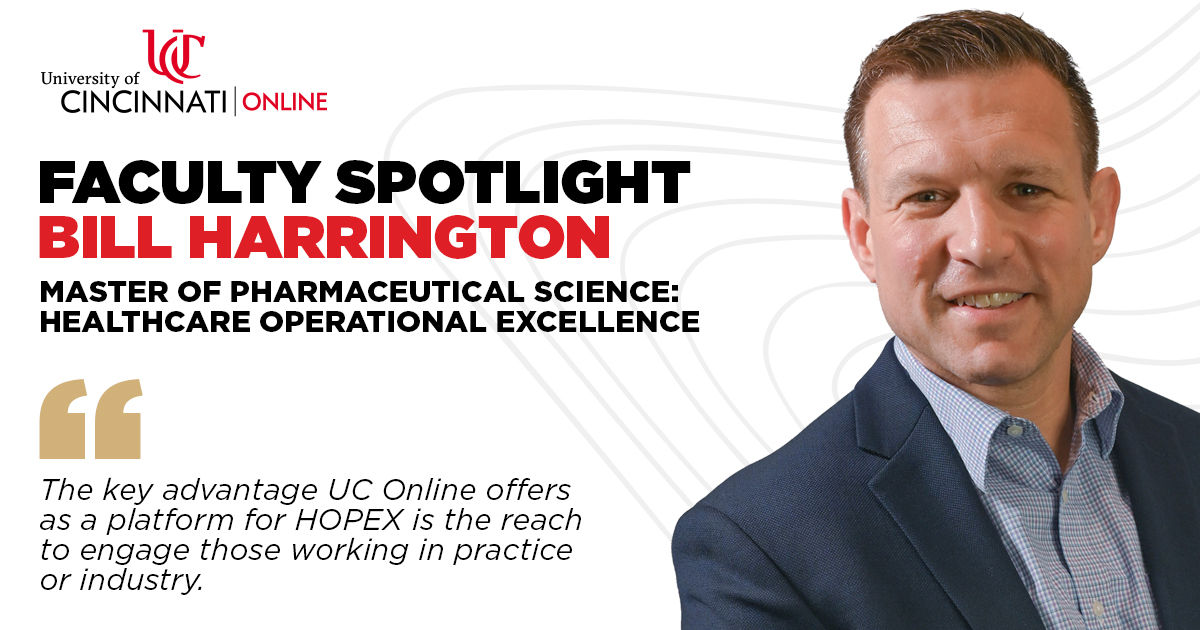
“The key advantage that UC Online offers as a platform for HOPEX is the reach to engage those working in practice or industry,” he said. “The asynchronous format allows students to participate when their schedules permit and from wherever they are.”
He added that HOPEX graduates are well-suited to quality improvement roles in health care, insurance, and manufacturing. Beyond that, he believes that the skills fostered through HOPEX will benefit any operational leader.
Final Thoughts: Operational Excellence
“I strive to make operational excellence something easy to grasp, especially for the complex environments we see throughout healthcare,” Dr. Harrington said. “My philosophy is that there are two objectives that any leader should master in pursuing excellence. First, have a clear definition of what winning is. Second, get all stakeholders involved to have fun in the journey of learning how to win.”
At its core, HOPEX is aligned with this philosophy. Through their coursework, capstone projects, and hands-on career experiences, HOPEX students hone the skills required to master these two objectives.
Striving for Growth and Efficiency? Explore HOPEX at UC
We’re so thankful to Dr. Harrington for taking the time to speak with us about the exciting future of HOPEX.
Are you considering where to take your career next? Does improving operational efficiency and providing excellent patient care excite you? If so, earning your Master’s in Healthcare Operational Excellence may be your next step. This online program is ideal for busy professionals who aim to apply their education directly to their career.
To learn more about HOPEX, connect with your Enrollment Services Advisor today. Make a difference in the lives of patients tomorrow.

Ready to get started?
We offer over 130 degrees from undergraduate to doctoral programs. Each program is supported by a team of Enrollment Services Advisors (ESAs) who are here to help answer any questions you have.