Online Executive Master of Health Administration

Program Overview
*The Executive Master of Health Administration program at the University of Cincinnati is an online graduate degree through the College of Allied Health Sciences. This website is designed to cover all online programs that the University of Cincinnati offers.
What is an Executive Health Administration degree?
Health administration can take many shapes and forms, but is most commonly referred to as the application of leadership skills and strategies to a wide range of health care entities. Our executive MHA program is designed for mid-career health professionals that are looking to move into an executive role within their organization.
Health care administrators, also known as health care managers or health service managers, are responsible for the day-to-day operations of health care entities. They provide executive leadership and oversight in policies and procedures, strategic vision and direction, finance and costs, and quality of care. An Executive MHA degree equips graduates with a wide range of knowledge, skills, and competencies essential for the provision of effective health care.
Mission Statement
The mission of the University of Cincinnati’s innovative on-line Executive Master of Health Administration (EMHA) Degree Program is to provide working professionals who might not have ready access to traditional educational routes with a high-quality experiential and practice oriented curriculum in healthcare management, preparing them to serve as innovative, transformative, ethical healthcare leaders within teams, organizations and health systems.
We offer a competency-driven, evidence-based curriculum which, by including both academics and practitioners as faculty, is adaptive to the ever-changing healthcare environment encouraging lifelong learning. Our on-line approach is designed both to expand access and to allow mid-level and other working health professionals to develop and enhance nationally recognized competencies. Our faculty are committed to discovery, integration, application, and teaching. They create an online learning environment that is research-based and service-oriented, and which assures the best possible educational experience for all students, including individualized learning paths when necessary.
Vision Statement
The vision of the UC Executive MHA program is to be acknowledged as a national leader in leveraging online educational technology to prepare future leaders for the ever-changing healthcare environment. The faculty have been nationally recognized for published and presented research.
Our graduates will be further proof of our efforts:
- their evaluations will guide us
- their efforts will be recognized by their supervisors, colleagues, patients, and organizations as characterizing curious, competent, and compassionate stewards of the public and institutional trust, and
- their performance will reflect honor upon their alma mater, their employers, and their profession
Values Statement
The University of Cincinnati’s Executive Master of Health Administration degree program values a conception of the healthcare leader as a true health professional, rather than solely a manager. In this, we are in strong support of the American College of Healthcare Executives’ (ACHE) Code of Ethics, with its focus on the healthcare managers responsibilities to:
- the profession
- patients or others served
- the organization and employees
In our faculty we value:
- a commitment to teaching informed by research and/or practice
- a dedication to service, whether to university, profession, or community
- the understanding that our learners are adults who are working and living full lives while improving their education
- a cooperative, collegial approach that allows for the development and maintenance of an integrated practice-oriented curriculum
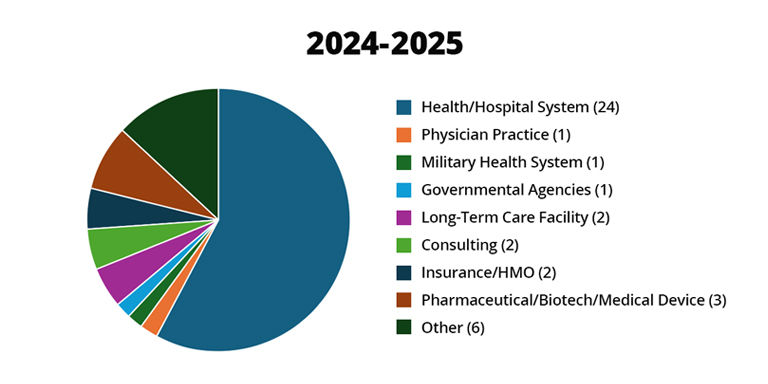
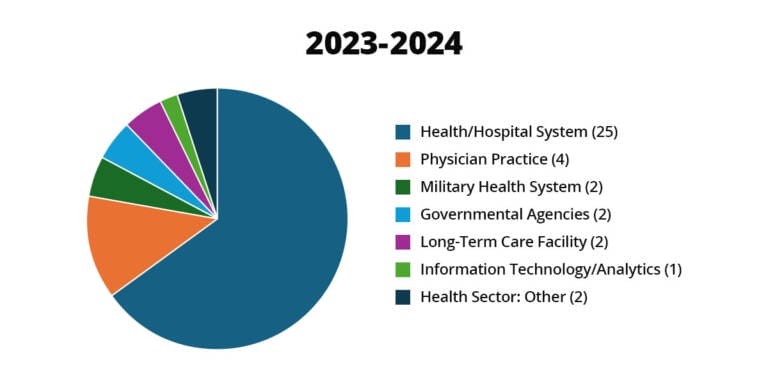
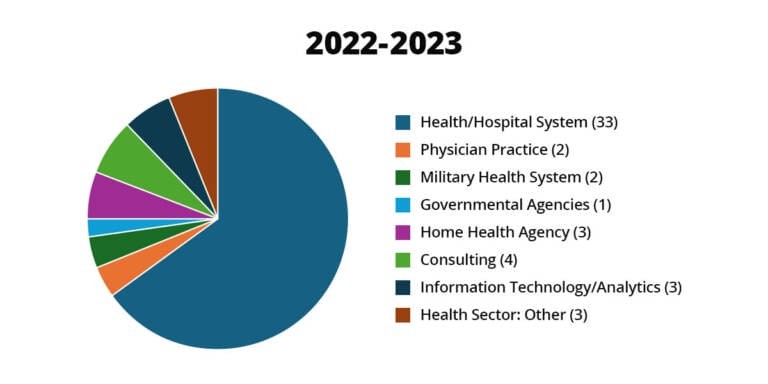
The following data reflects career outcomes for the graduates who completed the program between Fall 2022- Summer 2025.
| Year | Net Promoter Score | |
| 2021-2022 | 72 | |
| 2022-2023 | 86 | |
| 2023-2024 | 91 | |
| 2024-2025 | 89 |
To view additional program data and outcomes, please visit our accreditor, Commission on Accreditation of Healthcare Management Education (CAHME).
Program Highlights
High Quality Education
- CAHME Accredited
- Learn from world-class faculty
- Growing industry — 32% growth between 2019-2029
- Apply lessons learned immediately in your career
- 100% online
- No GRE/GMAT required
- Two program duration options (Fast-Track or Extended)
Flexibility
- 100% online
- No GRE/GMAT required
- Two program duration options (Fast-Track or Extended)
Support from Application through Graduation
At UC, you’ll have a full support team behind you:
Enrollment Services Advisor: Your partner through the application process, getting enrolled, and starting your program
Student Success Coordinator: Helping you prepare for classes and stay on track
Access to Resources: Access to university resources that will support you through your program including online learning expectations and resources, health and wellness resources, and academic support
Support is key to student success and at the University of Cincinnati, we provide as many points of contact as possible. From faculty advisors and program managers to student success coordinators, there is always someone available to answer questions, give advice, and clarify any confusions you may encounter.
Faculty Advisors
Provides guidance to maximize the student’s academic experience, career mentoring support, and encouragement.
- When you have questions regarding the curriculum such as content areas, scheduling offerings and strategies for academic success
- When you want to learn about the Program, College of Allied Health Sciences and/or University career development resources
- When you want to explore expanding your current network scope
- When you have questions about career development and paths
Program Manager
Start to finish program support resource, providing support to students during orientation and graduation.
- When you have a question during orientation
- When you add/drop/withdraw from a course
- When you need to request a new program plan
- When you have questions or concerns with courses/instructors
- When you have questions relating to graduation
Student Success Coordinator
Start to finish student support resource providing success strategies, enrollment reminders, and program date reminders.
- When you have questions about registration or textbooks
- When you have feedback regarding courses or instructors
- When you aren’t sure who to ask
Executive Master of Health Administration Executive Advisory Board
The University of Cincinnati’s online Executive Master of Health Administration (MHA) program is supported by an Advisory Board consisting of 12 to 15 local and national leaders from the healthcare administration field who serve as advisors, ambassadors, and referral agents to the program. The multidisciplinary and diverse backgrounds of the Advisory Board members promote the development and growth of the UC Executive MHA program. Program Leadership uses the advice of Advisory Board members to help guide the strategic planning of the MHA program.
MHA Advisory Board 2025-2026 Roster
BOARD MEMBER |
TITLE |
|
William (Bill) Kirkwood, MHSA, PhD |
Program Director and Associate Professor, UC MHA |
William.kirkwood@uc.edu |
Shane Knisley, MHA, FACHE |
President/CEO, Mercy Clermont |
swknisley@mercy.com |
Katheryn Hawkins |
UC Director, Strategy & Business Development |
katheryn.hawkins@uchealth.com |
Lauree Handlon, MHA, RHIA, CRCR, CCS, CSAF, FAHIMA, FHFMA |
UC MHA Alum; Director of Data Quality & Reimbursement, Cleverley & Associates |
lhandlon@cleverleyassociates.com |
Tiffany Porter Shabazz, Med |
Director of Development, UC Foundation |
smithtf@foundation.uc.edu |
William (Bill) Banks, MHA, MS-NET |
VP Managed Care/Revenue Cycle, St. Elizabeth |
bill.banks@stelizabeth.com |
David Muggli, RN, NEA-BC, FACHE |
CEO, Select Specialty Hospital of Cincinnati; Treasurer, ACHE of Greater Cincinnati |
DMuggli@selectmedical.com |
Rob Marty, DBA, MHA |
UC MHA Alum; COO, Case Specific Nutrition |
robmarty1300@gmail.com |
Jenelle Sobotka, BS, PharmD, FAPhA, FNAP |
Director of Graduate Programs in Pharmacy Leadership, UC College of Pharmacy |
sobotkje@ucmail.uc.edu |
Tim Ko, MBA, CMA |
CFO, Kettering Physician Network |
timothy.ko@ketteringhealth.org |
Amanda Koch, MBA, FACHE |
Director of HR, Kettering Health Network |
amanda.koch@ketteringhealth.org |
Ron Rohlfing, RRT, MBA |
VP of Operations, UC Health West Chester |
ronald.rohlfing@uchealth.com |
Karthik Ramani, MD, MHA, CPE, FACP, FASN, FASDIN |
Physician and Medical Director, Interventional Nephrology at University of Michigan; MHA Alum |
drkarthikramani@gmail.com; ramanik@med.umich.edu |
Greg Aukerman |
Outcomes-Institute |
gaukerman@outcomes-institute.org |
Bethany Chapman, MHA, BSN, RN |
MHA Alumni Association President, COO KJTC Consulting Services Limited |
chapmabh@ucmail.uc.edu |
Curriculum
The Executive Master of Health Administration degree from the University of Cincinnati Online features interdisciplinary coursework provided by both the College of Allied Health Sciences and the Carl H. Lindner College of Business. The online EMHA curriculum consists of 40 semester credits, including two introduction courses, nine core courses and a two-part capstone course. Students take courses part-time, between six and nine credit hours per semester.
View the extended track major map
| Course | Title/Description | Credit |
|---|---|---|
| HCA 7001 | Health Systems Management 1: Organization & Delivery The course is intended to provide the Executive Master of Health Administration (EMHA) student and future manager with a systems perspective of US health and health care structure and function. As the introductory course in the MHA program, it is to provide the fundamentals for all courses that follow, including finance and economics, strategy, quality improvement, policy and law, and others. Topics include an overview of the history, organization, and effectiveness of United States health care and public health systems, health system governance structures, roles, responsibilities as well as determinants of health, need, access and utilization. Teaching methods include: lectures, readings, interactive debate discussion boards, case studies. Learning methods include: discussion – and scenario-based inquisition, with active learning in problem-based case studies Assessment methods: position papers, interactive discussion debate |
3 |
| HCA 7033 | Global Health Systems This foundational course uses the subject matter of global health to teach students the critical management skill of how to analyze the structure and functions of health care systems. Once mastered, these skills can be applied to the assessment of systems at any level and in any type of community or setting. As the COVID 19 pandemic has demonstrated to all, American health care managers work in a world where global health issues are of immediate and critical relevance to strategic and day-to-day operations. The building blocks of health care systems, their impacts on intermediary and outcome variables, and key stakeholder and other analytical tools will be applied to various national systems from high and low resource nations around the world. Cultural, social, environmental and other variables impacting understandings of health and illness, and the policies and systems built to address them, will be examined. In addition to institutional health care systems, the roles played by the marketplace, transnational organizations, private entities and others in global health care will be explored. Teaching methods include: active learning exploration, lectures, readings, interactive debate discussion boards, case studies and group assignments Learning methods include: discussion – and scenario-based inquisition, with active learning focusing on group assignments and written assignments Assessment methods: interactive discussion boards, case-study based written assignments, self-reflection tools, insight inventory |
3 |
| Course | Title/Description | Credit |
|---|---|---|
| HCA 7002 | Health Systems Management 2: Principles of Leadership This course provides an introduction and overview to healthcare leadership, human resources management, and organizational behavior in healthcare settings, reflecting the uniqueness of this sector as well as the universal concepts and principles utilized in the development of effective healthcare administrators and leaders. This course integrates theory with practice through readings, written assignments, group projects, and discussion boards from different organizational perspectives. The development of leadership, managerial and organizational skills will be accomplished through a strong emphasis on self-reflection and self-analysis utilizing the tools of the course. This course aims to provide a relevant understanding of organizational dynamics such as performance, organizational culture, teamwork, individual and shared values, and cultural competency. It will examine how healthcare leaders and their organizations relate to each other internally and to their external environments. Topics include values-driven leadership, team effectiveness, self-awareness, emotional intelligence, conflict management, human resources management, employee behavior and appraisal, and assessment and evaluation of leadership performance. This course emphasizes the reflection of the students’ past and current experiences with the integration of current evidence-based leadership and human resources management principles. The students will be required to submit their feedback from self-evaluation assignments, surveys, inventory tools, and group work that is intended to provide insight, awareness, interdisciplinary collaboration, and professional and personal development for ongoing growth in healthcare leadership roles. |
3 |
| FIN 7021 | Health Care Finance 1: Analysis This course covers financial and managerial aspects of health care financial management. It provides a broad introduction to key concepts, issues, tools, and vocabulary useful both for managers and policymakers. There are three main topic areas covered in the course: financial accounting, finance, and managerial accounting and the focus is on use, not the preparation, of accounting information. Topics include financial analysis and management; methods and techniques for evaluating costs and cost-effectiveness of health, medical and pharmaceutical interventions. This course is the first of a two-course sequence in health care finance. Teaching methods include: active learning exploration, lectures, readings, evidence-based case studies Learning methods include: discussion – and scenario-based inquisition, with active learning focusing on case-based, problem-based, and collaborative learning Assessment methods: case-study based written assignments and group/collaborative activities focusing on finance in the healthcare setting |
3 |
| FIN 7022 | Health Care Finance 2: Decision Making This course builds on the accounting and financial concepts introduced in FIN 7021. The continued exploration of the healthcare environment includes an in-depth examination of third-party payer systems including managed care plus the legal and regulatory environment, particularly for non-profits. There are four main financial topic areas covered in the course: capital acquisition and structure, financial condition analysis and forecasting, revenue cycle management and capital allocation. This course is the second of a two-course sequence in health care finance. Teaching methods include: active learning exploration, lectures, readings, evidence-based case studies Learning methods include: active learning focusing on case-based, problem-based, and collaborative learning Assessment methods: quizzes, exams, case-study based written assignments focusing on finance in the healthcare setting |
3 |
| ECON 7021 | Health Care Marketplace 1: Health Economics The goal of this course is use economic analysis to introduce and to understand the basic elements and dynamics of the US healthcare system with a particular emphasis on policy implications. Over the past 50 years, the size and scope of the US healthcare economy has grown considerably. In 1960, the US spent about 5% of its gross national product on health. Current GDP on health is approximately 18%, far higher than other industrialized countries. The greater spending, however, does not seem to have purchased much better health. Why does the United States spend so remarkably on medical care for results that are not so remarkable? In seeking explanations and solutions, we will study the healthcare system in the United States and understand the factors that drive our appetite for healthcare goods and services. We will then examine alternatives to our current system, paying special attention to the ongoing legislative reform efforts coming from Washington DC. |
3 |
| MGMT 7022 | Health Care Marketplace 2: Strategic Success This course follows ECON 7021 and introduces the principles, methods and concepts of three different aspects of strategic management as it relates to health care organizations: 1) strategic planning and management, 2) competitive positioning and 3) alliances, mergers and acquisitions. Methods of evaluating and analyzing the external environment will include discussions of regulatory control, consolidation of industries, disruptive technologies and crisis/prevention management. The interaction of forces inside the organization such as structure, governance, resource management and culture will be analyzed for their impact on the organization’s competitive position and strategic direction. Teaching methods include: lectures, readings, evidence-based case studies Learning methods include: active learning focusing on case-based and problem-based, strategic and information-based group case assignment Assessment methods: independent and group-based case-study based written assignments focusing on strategy and governance in the healthcare setting |
3 |
| HCA 7041 | Health Quality 1: Evidence-Based Decision Making for Managers This course includes both theoretical models for health care quality work, as well as practical strategies for application and implementation of improvement initiatives in a health care setting. The course will review the Institute of Medicine’s Aims to drive safe, effective, efficient, timely, patient centered and equitable care. Students will learn various sources and categories of data that have proved useful in driving outcomes through quality improvement. It delineates the qualitative and quantitative quality improvement strategies employed by managers to engage in effective decision-making. Teaching methods include: lectures, readings, evidence-based case studies Learning methods include: active learning focusing on case-based and problem-based, strategic and information-based group case assignment Assessment methods: independent and group-based case-study based written assignments, written exams |
3 |
| HI 7010 | Health Informatics, Information Systems and Technology This course introduces the discipline of health informatics and covers emerging trends. Various information systems, technologies and applications utilized in the context of health and healthcare are introduced. Their characteristics, strengths, challenges, purpose and impact are taught. Impact on patients, populations and healthcare providers is emphasized. Factors influencing adoption and use of various clinical and health information systems and technologies are taught. Key information technologies and systems such as electronic health records, health information exchanges, personal health records, public health information systems and mobile health technologies are introduced in this course. Topics such as telemedicine, interoperability and technical concepts are taught, and evaluation framework is introduced. |
3 |
| HCA 7031 | Health Policy 1: Health Policy & Regulation This course is designed to provide students with an overview of the structure, systems and policies of health care delivery in the United States. Topics include the uninsured, health care professions, hospitals, long-term care, mental health, integrated health care systems, the Veterans Administration Health Systems, pharmaceuticals and technology. The course prepares learners about the basic concepts in policy analysis and advocacy in practice settings. Discussions and assignments will focus on the development of public policy concerning medical care, public health and the relationship between public decisions and the marketplace. Topics include health policy formulation, implementation and evaluation. |
3 |
| HCA 7032 | Health Policy 2: Legal & Ethical Issues This course presents an introduction to the legal and ethical issues that arise in management of health services organizations. Topics include ethics in business and clinical decision-making, tools for understanding ethics and ethical analysis, and professional and organizational guidelines in making ethical decisions. The course examines codes of ethics and mission statements, organizational responses to ethical issues, including ethics processes, such as institutional ethics committees and institutional review boards. Additionally, the course will review legal principles and development, application and assessment, resource allocation and social responsibility. Other topics include liability, health care institutions as corporations, the nature and scope of public health authority, antitrust, fraud and abuse, privacy and confidentiality, tax implications, regulatory oversight, legal requirements for access to health care, nondiscrimination, conflicts of interest and constitutional constraints on public health initiatives. Teaching methods include: lectures, readings, live webinar Learning methods include: active learning Assessment methods: quizzes and exams |
3 |
| Course | Title/Description | Credit |
|---|---|---|
| HCA 7081 | Capstone Course - Emerging Issues in Health Systems Management This course is the first of two half-semesters of the Master of Health Administration (MHA) Capstone course sequence. It is intended to integrate the foundational courses provided throughout the MHA program to help the student begin the capstone process. The goal of this course is to provide the student with the foundation needed to work toward developing the key competencies required for the creation of the health systems management capstone assignment in the final semester of the MHA Program. Some of the key competencies are: the ability to understand problems and emergent issues; mobilization to address issues through communication; analyze an emergent issue and synthesize current peer-reviewed literature; create best practice and evidence-based solutions to the emergent issue; seek information and apply analytical thinking skills through innovative thinking; create cost benefit analyses and financial support in order to solve an emergent issue; and, the ability to analyze federal, state, and local policies in application to resolve an emergent issue. Teaching methods include: lectures, readings, live webinars Learning methods include: active, inquiry-based and problem-based learning Assessment methods: research framework, logic model, literature review outline |
3 |
| HCA 7099 | Capstone Course - Health Systems Management In this course, students demonstrate how the knowledge and skills learned in their Master of Health Administration Program can be integrated and applied to analyzing an emerging health systems management issue of their choosing. This is the second course in the Capstone sequence. The student will engage in the following processes: write a literature review through the analysis and synthesis of the identified literature; discuss best practice solutions to the emergent issue; determine implications and recommendations utilizing best practice; utilize the expertise of the mentor to further enhance the quality of the paper; and, write a publishable paper. Teaching methods include: lectures, readings, live webinars Learning methods include: active, inquiry-based and problem-based learning Assessment methods: publishable written paper, peer-review of capstone, oral communication presentation |
4 |
| Course | Title/Description | Credit |
|---|---|---|
| HCA 7001 | Health Systems Management 1: Organization & Delivery The course is intended to provide the Executive Master of Health Administration (EMHA) student and future manager with a systems perspective of US health and health care structure and function. As the introductory course in the MHA program, it is to provide the fundamentals for all courses that follow, including finance and economics, strategy, quality improvement, policy and law, and others. Topics include an overview of the history, organization, and effectiveness of United States health care and public health systems, health system governance structures, roles, responsibilities as well as determinants of health, need, access and utilization. Teaching methods include: lectures, readings, interactive debate discussion boards, case studies. Learning methods include: discussion – and scenario-based inquisition, with active learning in problem-based case studies Assessment methods: position papers, interactive discussion debate |
3 |
| HCA 7002 | Health Systems Management 2: Principles of Leadership This course provides an introduction and overview to healthcare leadership, human resources management, and organizational behavior in healthcare settings, reflecting the uniqueness of this sector as well as the universal concepts and principles utilized in the development of effective healthcare administrators and leaders. This course integrates theory with practice through readings, written assignments, group projects, and discussion boards from different organizational perspectives. The development of leadership, managerial and organizational skills will be accomplished through a strong emphasis on self-reflection and self-analysis utilizing the tools of the course. This course aims to provide a relevant understanding of organizational dynamics such as performance, organizational culture, teamwork, individual and shared values, and cultural competency. It will examine how healthcare leaders and their organizations relate to each other internally and to their external environments. Topics include values-driven leadership, team effectiveness, self-awareness, emotional intelligence, conflict management, human resources management, employee behavior and appraisal, and assessment and evaluation of leadership performance. This course emphasizes the reflection of the students’ past and current experiences with the integration of current evidence-based leadership and human resources management principles. The students will be required to submit their feedback from self-evaluation assignments, surveys, inventory tools, and group work that is intended to provide insight, awareness, interdisciplinary collaboration, and professional and personal development for ongoing growth in healthcare leadership roles. |
3 |
| HCA 7033 | Global Health Systems This foundational course uses the subject matter of global health to teach students the critical management skill of how to analyze the structure and functions of health care systems. Once mastered, these skills can be applied to the assessment of systems at any level and in any type of community or setting. As the COVID 19 pandemic has demonstrated to all, American health care managers work in a world where global health issues are of immediate and critical relevance to strategic and day-to-day operations. The building blocks of health care systems, their impacts on intermediary and outcome variables, and key stakeholder and other analytical tools will be applied to various national systems from high and low resource nations around the world. Cultural, social, environmental and other variables impacting understandings of health and illness, and the policies and systems built to address them, will be examined. In addition to institutional health care systems, the roles played by the marketplace, transnational organizations, private entities and others in global health care will be explored. Teaching methods include: active learning exploration, lectures, readings, interactive debate discussion boards, case studies and group assignments Learning methods include: discussion – and scenario-based inquisition, with active learning focusing on group assignments and written assignments Assessment methods: interactive discussion boards, case-study based written assignments, self-reflection tools, insight inventory |
3 |
| Course | Title/Description | Credit |
|---|---|---|
| FIN 7021 | Health Care Finance 1: Analysis This course covers financial and managerial aspects of health care financial management. It provides a broad introduction to key concepts, issues, tools, and vocabulary useful both for managers and policymakers. There are three main topic areas covered in the course: financial accounting, finance, and managerial accounting and the focus is on use, not the preparation, of accounting information. Topics include financial analysis and management; methods and techniques for evaluating costs and cost-effectiveness of health, medical and pharmaceutical interventions. This course is the first of a two-course sequence in health care finance. Teaching methods include: active learning exploration, lectures, readings, evidence-based case studies Learning methods include: discussion – and scenario-based inquisition, with active learning focusing on case-based, problem-based, and collaborative learning Assessment methods: case-study based written assignments and group/collaborative activities focusing on finance in the healthcare setting |
3 |
| FIN 7022 | Health Care Finance 2: Decision Making This course builds on the accounting and financial concepts introduced in FIN 7021. The continued exploration of the healthcare environment includes an in-depth examination of third-party payer systems including managed care plus the legal and regulatory environment, particularly for non-profits. There are four main financial topic areas covered in the course: capital acquisition and structure, financial condition analysis and forecasting, revenue cycle management and capital allocation. This course is the second of a two-course sequence in health care finance. Teaching methods include: active learning exploration, lectures, readings, evidence-based case studies Learning methods include: active learning focusing on case-based, problem-based, and collaborative learning Assessment methods: quizzes, exams, case-study based written assignments focusing on finance in the healthcare setting |
3 |
| ECON 7021 | Health Care Marketplace 1: Health Economics The goal of this course is use economic analysis to introduce and to understand the basic elements and dynamics of the US healthcare system with a particular emphasis on policy implications. Over the past 50 years, the size and scope of the US healthcare economy has grown considerably. In 1960, the US spent about 5% of its gross national product on health. Current GDP on health is approximately 18%, far higher than other industrialized countries. The greater spending, however, does not seem to have purchased much better health. Why does the United States spend so remarkably on medical care for results that are not so remarkable? In seeking explanations and solutions, we will study the healthcare system in the United States and understand the factors that drive our appetite for healthcare goods and services. We will then examine alternatives to our current system, paying special attention to the ongoing legislative reform efforts coming from Washington DC. |
3 |
| MGMT 7022 | Health Care Marketplace 2: Strategic Success This course follows ECON 7021 and introduces the principles, methods and concepts of three different aspects of strategic management as it relates to health care organizations: 1) strategic planning and management, 2) competitive positioning and 3) alliances, mergers and acquisitions. Methods of evaluating and analyzing the external environment will include discussions of regulatory control, consolidation of industries, disruptive technologies and crisis/prevention management. The interaction of forces inside the organization such as structure, governance, resource management and culture will be analyzed for their impact on the organization’s competitive position and strategic direction. Teaching methods include: lectures, readings, evidence-based case studies Learning methods include: active learning focusing on case-based and problem-based, strategic and information-based group case assignment Assessment methods: independent and group-based case-study based written assignments focusing on strategy and governance in the healthcare settin |
3 |
| HCA 7041 | Health Quality 1: Evidence-Based Decision Making for Managers This course includes both theoretical models for health care quality work, as well as practical strategies for application and implementation of improvement initiatives in a health care setting. The course will review the Institute of Medicine’s Aims to drive safe, effective, efficient, timely, patient centered and equitable care. Students will learn various sources and categories of data that have proved useful in driving outcomes through quality improvement. It delineates the qualitative and quantitative quality improvement strategies employed by managers to engage in effective decision-making. Teaching methods include: lectures, readings, evidence-based case studies Learning methods include: active learning focusing on case-based and problem-based, strategic and information-based group case assignment Assessment methods: independent and group-based case-study based written assignments, written exams |
3 |
| HI 7010 | Health Informatics, Information Systems and Technology This course introduces the discipline of health informatics and covers emerging trends. Various information systems, technologies and applications utilized in the context of health and healthcare are introduced. Their characteristics, strengths, challenges, purpose and impact are taught. Impact on patients, populations and healthcare providers is emphasized. Factors influencing adoption and use of various clinical and health information systems and technologies are taught. Key information technologies and systems such as electronic health records, health information exchanges, personal health records, public health information systems and mobile health technologies are introduced in this course. Topics such as telemedicine, interoperability and technical concepts are taught, and evaluation framework is introduced. |
3 |
| HCA 7031 | Health Policy 1: Health Policy & Regulation This course is designed to provide students with an overview of the structure, systems and policies of health care delivery in the United States. Topics include the uninsured, health care professions, hospitals, long-term care, mental health, integrated health care systems, the Veterans Administration Health Systems, pharmaceuticals and technology. The course prepares learners about the basic concepts in policy analysis and advocacy in practice settings. Discussions and assignments will focus on the development of public policy concerning medical care, public health and the relationship between public decisions and the marketplace. Topics include health policy formulation, implementation and evaluation. |
3 |
| HCA 7032 | Health Policy 2: Legal & Ethical Issues This course presents an introduction to the legal and ethical issues that arise in management of health services organizations. Topics include ethics in business and clinical decision-making, tools for understanding ethics and ethical analysis, and professional and organizational guidelines in making ethical decisions. The course examines codes of ethics and mission statements, organizational responses to ethical issues, including ethics processes, such as institutional ethics committees and institutional review boards. Additionally, the course will review legal principles and development, application and assessment, resource allocation and social responsibility. Other topics include liability, health care institutions as corporations, the nature and scope of public health authority, antitrust, fraud and abuse, privacy and confidentiality, tax implications, regulatory oversight, legal requirements for access to health care, nondiscrimination, conflicts of interest and constitutional constraints on public health initiatives. Teaching methods include: lectures, readings, live webinar Learning methods include: active learning Assessment methods: quizzes and exams |
3 |
| Course | Title/Description | Credit |
|---|---|---|
| HCA 7081 | Capstone Course - Emerging Issues in Health Systems Management This course is the first of two half-semesters of the Master of Health Administration (MHA) Capstone course sequence. It is intended to integrate the foundational courses provided throughout the MHA program to help the student begin the capstone process. The goal of this course is to provide the student with the foundation needed to work toward developing the key competencies required for the creation of the health systems management capstone assignment in the final semester of the MHA Program. Some of the key competencies are: the ability to understand problems and emergent issues; mobilization to address issues through communication; analyze an emergent issue and synthesize current peer-reviewed literature; create best practice and evidence-based solutions to the emergent issue; seek information and apply analytical thinking skills through innovative thinking; create cost benefit analyses and financial support in order to solve an emergent issue; and, the ability to analyze federal, state, and local policies in application to resolve an emergent issue. Teaching methods include: lectures, readings, live webinars Learning methods include: active, inquiry-based and problem-based learning Assessment methods: research framework, logic model, literature review outline |
3 |
| HCA 7099 | Capstone Course - Health Systems Management In this course, students demonstrate how the knowledge and skills learned in their Master of Health Administration Program can be integrated and applied to analyzing an emerging health systems management issue of their choosing. This is the second course in the Capstone sequence. The student will engage in the following processes: write a literature review through the analysis and synthesis of the identified literature; discuss best practice solutions to the emergent issue; determine implications and recommendations utilizing best practice; utilize the expertise of the mentor to further enhance the quality of the paper; and, write a publishable paper. Teaching methods include: lectures, readings, live webinars Learning methods include: active, inquiry-based and problem-based learning Assessment methods: publishable written paper, peer-review of capstone, oral communication presentation |
3 |
The University of Cincinnati’s Executive MHA program is a competency-based program that utilizes several components of the National Center for Healthcare Leadership Competency Model 3.0 to measure student competency attainment throughout the 13 courses in the program.
While all components of the NCHL model are valuable to promote leadership growth and professional development for healthcare professionals, the UC Executive MHA program adopted 14 of the 26 competencies that are directly measurable and well-suited for assessment in a fully online curriculum designed for experienced working professionals.
Admission Requirements
Prerequisites
- Students applying to the executive MHA program must have completed a Bachelor Degree program from a regionally accredited institution.
- Executive MHA Applicants must have completed Bachelor Degree program with a minimum cumulative GPA of 3.0 (4.0 scale).
Complete the online application and submit the application fee.
Standard Application Fees:
- $65.00 for domestic applicants to most degree programs
- $70.00 for international applicants to most degree programs
- $20.00 for domestic applicants to Graduate Certificates
- $25.00 for international applicants to Graduate Certificates
- Application fees are waived for Summer 2026 applications submitted by March 1st, 2026
- Application fees are waived for Fall 2026 applications submitted by July 1st, 2026
- Fee waivers are automatically applied for applicants who:
- are currently serving in the US armed forces
- are veterans of the US armed forces
All applicants are required to upload unofficial transcripts during the application process, showing all undergraduate and graduate course work completed, including degrees granted and dates of conferral.
Official transcripts are not required until the student has received and accepted an offer of admission from the university. Once the offer has been confirmed, the student must submit official transcripts.
Students who have received degrees from the University of Cincinnati do not need to submit official paper copies of their UC transcripts.
Transcripts can be submitted electronically or by mail. To see if your transcript(s) can be ordered electronically, visit the links below and search for your previous school(s).
- Parchment
- Please select “University of Cincinnati – Main Campus” as the recipient of your transcript.
- National Student Clearinghouse
- Please have your transcript sent directly to admissions@uc.edu.
If you do not see your past school(s) listed on either site, please contact the school(s) directly. Then, mail your sealed, unopened, official transcripts to:
Please mail sealed, unopened, official transcripts to:
University of Cincinnati
Office of Admissions
PO Box 210091
Cincinnati, Ohio 45221-0091
Two letters of recommendation that address the executive MHA applicant’s academic readiness for graduate-level work, work ethic and habits, and the applicant’s communication and interpersonal skills.
*Letters of recommendation from family, friends, current students, politicians, or clergy are not accepted.
Resume/CV of personal, professional and educational background. Executive MHA applicants are strongly encouraged to highlight experience in health care.
Personal statement or brief essay (no more than three pages double-spaced) answering the following prompts:
- What are your academic goals?
- How will earning your MHA help you reach your professional goals?
- How will you balance work and your online program?
- What is your motivation for earning your MHA?
At least two years of work experience in a health care setting is preferred. Students transitioning from undergraduate health care degrees are encouraged to highlight experience through internships/practicums. Please highlight work experience within resume and personal statement.
- Students living abroad are eligible to pursue this program, but will not be qualified for F1 Visa applications.
- TOEFL minimum
– 580 (paper version), 237 (computer), or 93 (Internet) - IELTS minimum 6.5
- Duolingo 110
- International executive MHA applicants must also submit an external course-by-course evaluation of your foreign transcripts for evaluation to an agency recognized by the National Association of Credential Evaluating Services (NACES; www.naces.org).
Application Deadlines
| Term | Application Deadline | Classes Start |
|---|---|---|
Summer 2026 Fall 2026 Spring 2027 |
April 13, 2026 July 27, 2026 December 4, 2026 |
May 11, 2026 August 24, 2026 January 11, 2027 |
Tuition & Fees
The University of Cincinnati's online course fees differ depending on the program. On average, students will accrue fewer fees than students attending on-campus classes.
The one fee applied across all UC Online programs is the distance learning fee. Students living outside the state of Ohio must also pay an additional “non-resident” fee to enroll in courses at UC Online. This fee is lower than the out-of-state fee for traditional on-campus programs.
To view tuition information and program costs, visit the Online Program Fees page.
- College of Allied Health Sciences Online Grad Scholarship
- For new graduate students only
- May be offered a one time scholarship to be applied during their first term of $1000
- Number of scholarships awarded
- Spring Semester: 2
- Summer Semester: 1
- Fall Semester: 2
- Talk with your enrollment advisor to find out how to apply and when the deadline is!
- Military Affiliation Scholarship
- The University of Cincinnati Online is honored to support active military members and veterans as they pursue rewarding careers in healthcare. We understand the challenges faced by those transitioning from military service, and we’re committed to making your educational journey smoother and more affordable.
- The UC Online Military Scholarship offers:
- Financial assistance: Scholarships of up to $1,500 per semester can significantly reduce the cost of your online degree program.
- Flexibility: Our online format allows you to study on your own schedule and terms, accommodating your busy military life.
- Variety of programs: Choose from a range of online undergraduate and graduate programs within our College of Allied Health Sciences (CAHS). Explore exciting fields like medical laboratory science, health informatics, health administration, and more!
- Benefits for Active Military & Veterans:
- Convenience: Earn your degree online without relocating or disrupting your military commitments.
- Skill development: Gain valuable healthcare knowledge and skills that translate well into civilian careers.
- Career advancement: Increase your earning potential and job opportunities within the growing healthcare industry.
- Eligibility & Requirements:
- Active Military and Veterans beginning their online UC career in CAHS Summer 2024 or after may be eligible for a UC scholarship of up to $1,500/semester.
- Undergraduate must take a minimum of 6 credit hours/semester.
- Graduate students must take a minimum of 5 credit hours/semester.
- This scholarship is not available for certificate programs.
- Work with your enrollment advisor and student success coordinator to see if you are eligible!
- * The max number of installments will vary depending on the length of the program
- This scholarship program is open to active military members and veterans enrolled in a qualifying CAHS program at UC Online. Please note: Students utilizing certain VA benefits are not eligible. See the full list of excluded benefits below.
- Important Note: Students utilizing any of the following benefits are NOT eligible for this scholarship:
- Post 9/11 GI Bill (Chapter 33) at the 100% level
- Students who are dependents using the Post 9/11 GI Bill
- Veteran Readiness & Employment (Chapter 31) Benefit
- Ohio National Guard students receiving Tuition Assistance and Chapter 1606 GI Bill
- Survivor’s & Dependents Educational Assistance (Chapter 35)
- Ready to Take the Next Step?
- We’re here to support you! Our dedicated Enrollment Services Advisors can answer your questions, help you determine eligibility, and guide you through the application process.
Accreditation & Rankings

Accreditations and rankings for a college or university means that it has achieved and maintains high standards in education. These agency accreditations are also maintained in a database by the U.S. Department of Education.
Executive MHA designations:
- Accredited with the Commission of Accreditation of Healthcare Management Education (CAHME)
- Top tier of America’s Best Colleges by U.S. News & World Report
- Regionally accredited by the Higher Learning Commission
Faculty

Amy Bunger
Associate Professor, CAHS School of Social Work
1320 UCMC

William Kirkwood
Assoc Professor - Educator, CAHS Master of Health Administration
French Hall
In 2015, Bill began his career at University of Cincinnati as an adjunct in the then Masters in Health Administration Program. In the AY 2023/2024 he was appointed Visiting Professor in the Executive Master in Health Administration Program which he served for 2 years. In the AY 2025/2026 he was appointed the Program Director of the Executive MHA Program and Associate Professor.

Amanda Logan-Athmer, DHA, RDN, LD, FACHE
Dr. Amanda Logan-Athmer, CAHS School of Social Work
HSB

Rob Steven Marty
Adjunct Professor, College of Allied Health Sciences, CAHS School of Social Work
HSB

Karen E. Meyer
Program Manager, CAHS Communication Sciences & Disorders
356 HSB

Rebecca Ramirez
Instructor - Adjunct, CAHS School of Social Work
French Hall
Risk Management and matrix supervision experience, with over ten years in progressive roles with multi-location organizations.

Molly A Rogers
Assistant Professor - Adjunct, LCB Accounting
LINDHALL
Download vita.
Teaching Interest
Managerial Accounting, Cost Accounting, NonProfit, Financial Accounting, MBA Decision Making
Research Interest
Applying Accounting and Managerial Concepts to improve health care economics.
History
Institution: The Christ Hospital
Title: Consultant
Institution: Carmel Manor Nursing Home Board
Title: Chair of Audit committe and finance
Institution: Board of Directors Dental Care Plus, Inc.
Title: Finance and Audit Committee
Institution: Emerson Consulting
Title: Consultant
Institution: St. Elizabeth Healthcare
Title: Senior Director
End Date: 2013-07-31
Institution: Xavier University Masters of Health Administration
Title: Assistant Professor of Finance
End Date: 1998-05-12
Institution: University of Cincinnati
Title: Adjunct Professor
End Date: 1987-12-31
Institution: Ernst and Whinney
Title: staff, senior, manager auditor and consultant
End Date: 1987-08-31
Awards | Honors
Organization: College of Business
Name: Deans List of Teaching Excellence - Spring 2017
Year Received: 2017
Organization: College of Business
Name: Awarded Harold Grilliot Award
Year Received: 2017
Organization: College of Business
Name: Nomintated For the Michael Dean Award for Ouststanding Graduate teaching
Year Received: 2017
Organization: College of Business
Name: Deans List of Teaching Excellence - Fall 2016
Year Received: 2017
Organization: College of Business
Name: Deans List of Teaching Excellence - Summer 2016
Year Received: 2016
Organization: College of Business
Name: Deans List of Teaching Excellence - Spring 2016
Year Received:2016
Organization: College of Business
Name: Nominated for the Harold Grilliot Award for Outstanding Faculty Adivsor
Year Received: 2016
Organization: College of Business
Name: Nominated for the Michael Dean Award for Graduate Teaching
Year Received: 2016
Organization: College of Business
Name: Deans List of Teaching Excellence - Fall 2015
Year Received: 2016
Organization: BETA ALPHA PSI national
Name: BAP Awarded National Outstanding Chapter
Year Received: 2015
Organization: Carl H. Lindner College of Business
Name: Deans List of Teaching Excellence Summer 2015
Year Received: 2015
Organization: Carl H. Lindner College of Business
Name: Deans List of Teaching Excellence Spring 2015
Year

Ready to get started?
We offer over 130 degrees from undergraduate to doctoral programs. Each program is supported by a team of Enrollment Services Advisors (ESAs) who are here to help answer any questions you have.
Further action is required to make this script accessible
The below criteria must be satisfied:
- Affirm Accessibility must be checked AND
- You have an iFrame in the script without a title, use the 'iFrame Title' input to add one.
The script will not display on the live site until the issue above is resolved.